Interest in environmentally responsible procurement has encouraged many businesses to reconsider the products used in everyday housekeeping. As a result, Eco-Friendly Cleaning Products are increasingly considered by offices, hotels, institutions, restaurants, facility management companies, and other commercial establishments.
For buyers in Pune, Maharashtra, however, choosing such products requires more than selecting packaging that looks green or relying on broad environmental claims.
Start by Asking What Eco-Friendly Means
The term can refer to different characteristics depending on the product.
A cleaning product may aim to reduce environmental impact through its ingredients, concentration, packaging, manufacturing approach, biodegradability characteristics, or reduced use of certain substances.
Commercial buyers should therefore look beyond the label and understand what specific environmental attribute is being claimed.
Vague terminology is less useful than clear product information.
Concentration Can Affect Environmental Impact
Concentrated cleaning products can offer practical advantages because a smaller volume of concentrate may produce a much larger quantity of usable solution after dilution.
Depending on the product and packaging system, this can potentially reduce the number of containers that need to be transported, stored, and discarded.
However, the advantage depends heavily on correct dilution.
If housekeeping teams routinely overdose concentrate, some of the expected efficiency is lost.
Performance Still Matters
Environmental considerations should not mean accepting inadequate cleaning.
A product that needs repeated application, excessive scrubbing, or unusually high quantities to complete a task may create operational inefficiencies.
Commercial buyers should evaluate both environmental characteristics and real-world performance.
A controlled trial can examine:
- Cleaning effectiveness
- Dilution requirement
- Quantity used per task
- Ease of application
- Residue after cleaning
- Surface compatibility
- Staff feedback
- Packaging efficiency
This produces a more meaningful evaluation than choosing a product solely because of one marketing statement.
Packaging Deserves Attention Too
The cleaning formulation is only one part of the purchasing decision.
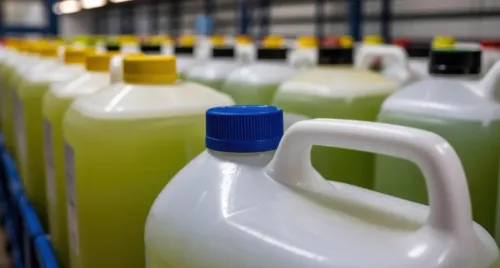
Bulk packs, refill systems, concentrated formats, and appropriately sized containers can influence how much packaging a commercial facility handles.
Large businesses should also consider whether pack sizes match their actual consumption. Purchasing unnecessarily small containers for a high-volume facility may increase packaging handling, while oversized packs may be inconvenient for smaller housekeeping teams.
Staff Behaviour Can Reduce Waste
Sustainable cleaning is partly a product issue and partly an operational issue.
Even thoughtfully selected products can be wasted through poor dispensing, uncontrolled pouring, incorrect dilution, unnecessary repeat cleaning, or improper storage.
Simple measures can help:
- Establish standard dilution procedures.
- Train housekeeping staff.
- Use measuring or dispensing systems where suitable.
- Track monthly consumption.
- Store products properly.
- Review unusual increases in usage.
These practices can support both environmental and cost objectives.
Think in Terms of the Whole Cleaning System
A facility looking to improve its environmental approach should review more than chemical formulations.
Microfiber systems, reusable tools, water usage, waste segregation, dosing practices, procurement frequency, and packaging disposal can all influence the overall housekeeping footprint.
For businesses in a large commercial and industrial market such as Pune, this broader perspective is particularly useful when managing multiple properties or high-volume cleaning operations.
ROHO CARE PVT. LTD supplies cleaning and hygiene solutions for commercial establishments, housekeeping businesses, institutions, and bulk buyers in Pune.
The practical question is not simply whether a product carries an eco-friendly description. Commercial procurement teams should examine what the claim means, whether the product performs effectively, how efficiently it is used, and whether it fits the facility's broader cleaning and waste-management practices.
Keywords